
From Police Humor to AI Video: How Officer Creators Are Changing Social Media
Written by DJ Akers on September 14, 2026
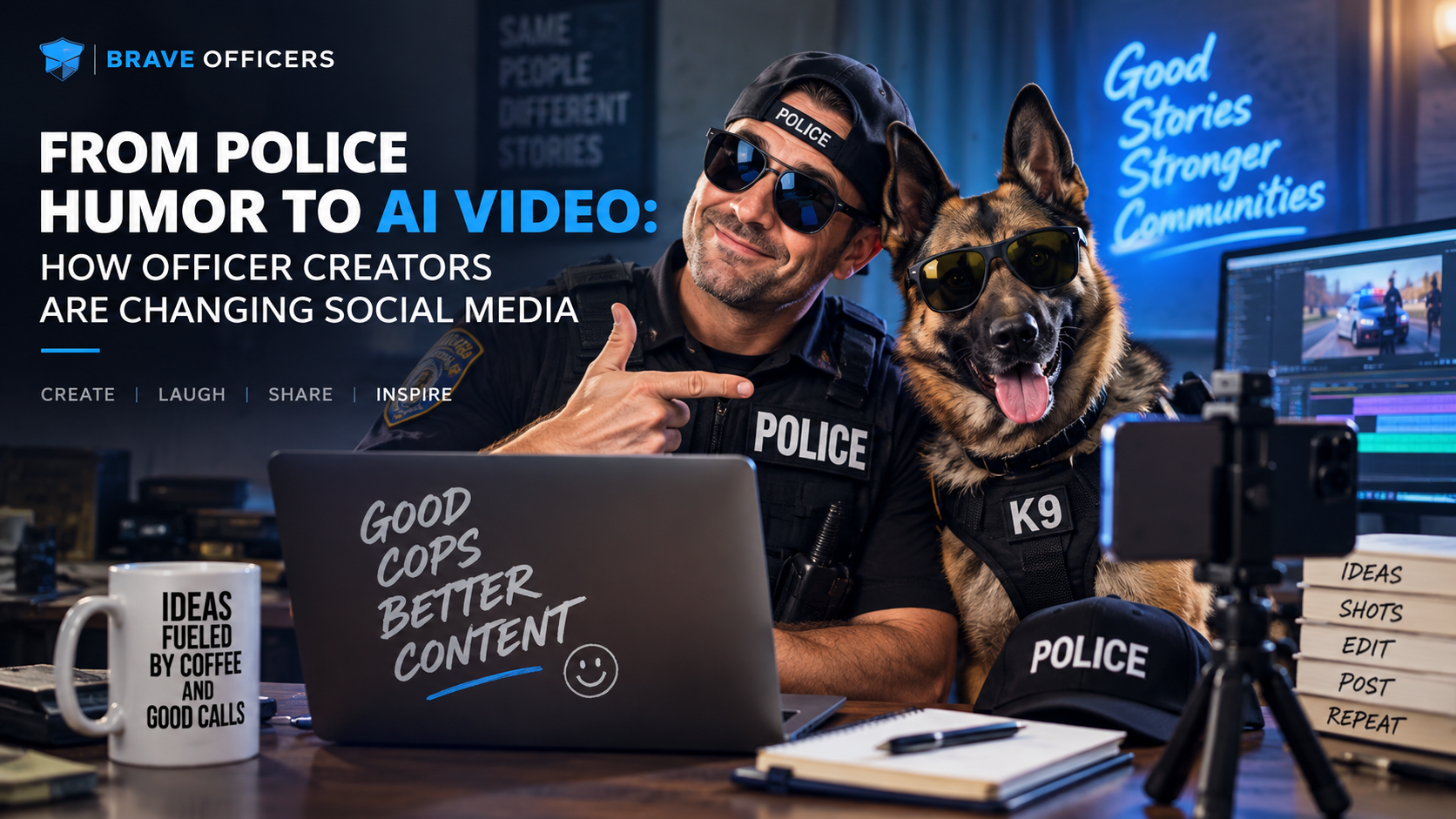
Police content on social media has changed dramatically over the last several years.
What was once dominated by official department announcements, press conferences, and public-information posts has expanded into something much broader.
Individual officers and police-focused creators are now building audiences around humor, personality, everyday experiences, behind-the-scenes moments, commentary, and relatable situations that people inside and outside law enforcement recognize immediately.
Short-form video has accelerated that shift.
Platforms such as TikTok, Instagram Reels, YouTube Shorts, and Facebook have made it possible for a single funny idea, familiar scenario, or well-timed joke to reach millions of people without a traditional media company behind it.
Now artificial intelligence is adding another layer to that creative process.
Police Creators Have Become Their Own Social Media Category
Some of the most successful police-related content online does not feel like traditional institutional communication.
It feels personal.
An officer makes a joke about something every patrol officer has experienced. A creator exaggerates an awkward interaction. A short video turns a familiar workplace situation into a sketch. A personality develops recurring characters, catchphrases, or formats that audiences begin to recognize.
That kind of content works because it gives people a more human view of the individuals behind the uniform.
It can also create a strong sense of community among officers, first responders, families, and audiences who enjoy the culture surrounding law enforcement.
The most effective videos often start with something extremely simple: a situation people immediately understand.
The creativity comes from what the creator does with it.
Humor Works Because It Is Relatable
Police humor has always existed offline.
Like many professions, law enforcement develops its own language, routines, inside jokes, frustrations, personalities, and situations that become instantly recognizable to the people who experience them.
Social media gives creators a way to translate those experiences into entertainment.
A joke about paperwork, night shifts, dispatch, equipment, training, supervisors, rookies, traffic stops, or the strange situations officers encounter can resonate because it starts with something familiar.
For audiences outside law enforcement, the same content can be entertaining because it reveals a side of police culture they do not normally see.
The best videos usually do not need to explain the joke at length.
The viewer recognizes the setup, understands the personality behind it, and gets the payoff quickly.
That is especially important in short-form video, where creators often have only a few seconds to capture attention.
Short-Form Video Changed What Police Creators Can Build
Before social platforms became major distribution channels, creating a recurring comedy series or building a recognizable media personality usually required access to television, radio, publishing, or a larger production organization.
That barrier has largely disappeared.
An individual creator can now develop an audience using nothing more than a phone, an idea, and a consistent point of view.
But as audiences have grown, expectations have grown too.
Creators are competing with increasingly polished content.
Viewers are accustomed to strong editing, visual effects, different camera treatments, quick pacing, unusual concepts, and formats that constantly evolve.
That can create a production challenge.
A creator may have a funny concept but not have access to a full production team, special effects, custom graphics, voice work, elaborate locations, or the time required to produce several different versions of the idea.
This is where AI-assisted creative tools are beginning to change what a small team or individual creator can do.
AI Expands the Number of Ideas Creators Can Actually Execute
One of the biggest advantages of generative AI is not simply that it can create images or video.
It can reduce the distance between an idea and something a creator can actually publish.
A police creator might imagine a scene that would traditionally require a difficult location, an elaborate visual effect, a specific background, a complicated edit, or production resources that are not readily available.
AI can make some of those ideas easier to explore.
A creator can experiment with visual concepts before filming.
A simple joke can be tested in several different creative directions.
Backgrounds, graphics, images, audio, and video elements can be developed more quickly.
Instead of abandoning an idea because it would be too expensive or time-consuming to produce, creators have more ways to find an alternative approach.
That does not mean every idea becomes good simply because it can be generated.
It means creators have a larger creative toolbox.
How Brave Officers Uses AI to Create Content
At Brave Officers, we use PixyDust as part of our creative process for developing entertaining content around police culture, officer personalities, humor, and social media.
That can include exploring visual concepts, developing creative assets, experimenting with different versions of an idea, and finding new ways to turn a joke or familiar police experience into a finished video.
Having AI-powered video, image, audio, and other creative capabilities available in one place gives us more flexibility during the production process.
An idea does not always begin as a fully developed script.
Sometimes it starts with a single funny observation, an exaggerated scenario, a visual gag, or a situation that officers immediately recognize.
AI tools can help us explore what that idea could become before we commit to one direction.
For us, that is where the value is strongest.
PixyDust does not decide what is funny.
It gives us more ways to execute the ideas we already want to create.
The Joke Still Has to Come From Somewhere
AI can make production easier, but it does not automatically make something entertaining.
A technically impressive video can still fall flat if the underlying idea is not funny, relatable, surprising, or interesting.
The same is true of police content.
The technology may help create the visual, but the creator still has to understand the experience behind the joke.
That understanding is often what separates content that feels authentic from content that feels generic.
A person who has spent time around law enforcement may recognize the small details that make a scenario funny.
The facial expression. The timing. The terminology. The type of personality involved. The moment when a routine situation becomes absurd.
Those details are difficult to replace because they come from experience and observation.
AI can assist with execution.
The perspective still comes from the creator.
AI Makes Experimentation Easier
Another advantage is the ability to try more ideas without treating every concept like a major production.
Traditional content production can create pressure to get everything right before publishing because each version takes time and resources to create.
AI-assisted workflows can make experimentation less expensive.
A creator can explore several visual treatments for the same concept.
A scene can be approached realistically, exaggerated for comedy, stylized, animated, or turned into something intentionally absurd.
Different versions can be evaluated before deciding what deserves further production.
That matters because social media is unpredictable.
The idea a creator thinks will perform best is not always the one audiences respond to.
Being able to experiment more often gives creators more opportunities to discover what actually works.
More Ambitious Concepts Become Possible
Humor often improves when creators can exaggerate reality.
A minor inconvenience can become a ridiculous scenario.
An everyday police situation can be transformed into something cinematic.
A simple interaction can be placed in an unexpected setting.
A familiar joke can become more memorable when the visual execution goes beyond what viewers expect.
Historically, those kinds of ideas could require specialized editing or production resources.
AI is making some of that creative experimentation more accessible.
That can be especially useful for independent creators who have strong ideas but limited time, staff, or production budgets.
The result is not necessarily more complicated content.
Sometimes it simply means a creator can finally produce the version of the joke that existed in their head.
Authenticity Still Matters
Police creators occupy an unusual space because their content often mixes entertainment with a profession that audiences take seriously.
That makes authenticity important.
Humor can exaggerate an experience without misleading people about whether something is real.
AI-generated scenes, synthetic footage, altered voices, and other creative elements should be used in ways that make sense for entertainment and do not create unnecessary confusion.
A clearly comedic scenario is very different from content that could be mistaken for authentic evidence, body-camera footage, surveillance video, or documentation of a real incident.
Creators should understand that distinction and use judgment when developing AI-assisted content.
The goal is to make something entertaining, not to make audiences uncertain about what actually happened.
Personality Is Still the Competitive Advantage
As AI creative tools become more widely available, access to the technology itself will become less unusual.
More creators will be able to generate polished visuals, experiment with effects, and produce content that once required significantly more technical knowledge.
That means personality becomes even more important.
Two creators can have access to the same tools and produce completely different results.
The difference is the idea, the sense of humor, the point of view, the timing, and the relationship each creator has with their audience.
People rarely follow a creator because of the software used to make the video.
They follow because they like the person, the perspective, or the type of content that person consistently creates.
AI can increase what a creator is capable of producing.
It cannot manufacture a genuine relationship with an audience.
The Future of Police Creator Content
Police creators will likely continue experimenting with increasingly sophisticated forms of digital entertainment.
Short-form video will evolve. AI video will become more controllable. Visual effects will become easier to produce. Audio tools will improve. Creators will be able to move from an idea to a finished concept faster than ever.
That could make police-focused social media more creative, more visual, and more ambitious.
But the fundamentals are unlikely to change.
The best content will still begin with a recognizable idea.
The joke still has to land.
The creator still needs a point of view.
And the audience still has to care enough to keep watching.
AI can give police creators more ways to turn those ideas into videos.
What makes those videos worth watching will still come from the people creating them.